
One technique at a time
Each lesson teaches a single formula, in the Japanese order: friends of 10 first, then friends of 5. Nothing is assumed before it is learned.
The Japanese method · kids ages 4 and up
With the Soroban, kids learn to add, subtract and calculate in their heads, one technique at a time. Short lessons, 18 games, timed challenges and an aquarium that grows with every practice, following the exam path of Japanese schools. In English or Spanish.
No credit card · 7 free lessons
Looking for memory exercises for adults? Memory program
Tap the beads to move them up or down.
Make the number 7
Level 1Your Soroban shows 0
🎨 Paint your Soroban
Beads
Frame
Your colors are saved for your lessons.
Learning by playing
Short lessons and lots of ways to practice, so ten minutes a day fly by.
For hands, eyes and mind: One touch, Mirror, Flash, The little shop and many more.
Every practice adds fish and plants to the aquarium. Parents can turn it off if they prefer the app without extras.
Hear numbers read out loud and count them on the Soroban, as in Japanese schools.
Red, blue or rainbow beads, and the frame you like best.
Every technique mastered earns a badge, and every day of practice grows the streak.
Pass an exam and get a diploma to print and hang on the wall.
The method
Each lesson teaches a single formula, in the Japanese order: friends of 10 first, then friends of 5. Nothing is assumed before it is learned.
Timed practice sheets and exams in the Japanese format: 15 problems in 7 minutes. Every attempt records time and accuracy.
Statistics and a parent dashboard: practice time, kyu reached and the next step. Progress you can see, not guess.
Multi-year trials with control groups show that children who practice Soroban and Anzan calculate faster and with fewer mistakes. Here's what they found.
The path
Each kyu ends with an exam, and passing it opens the next. Two paths that go together: the abacus in the hand and the abacus in the mind.
Format inspired by the exams of Zenshuren, the Japanese federation for Soroban education.
Addition and subtraction on the abacus, from reading the beads to carrying past the hundreds. Each exam: two sheets of 15 problems, 7 minutes each.
The imagined abacus: addition, multiplication and division with no Soroban in hand. Each subject: 3 minutes.
Who's behind it
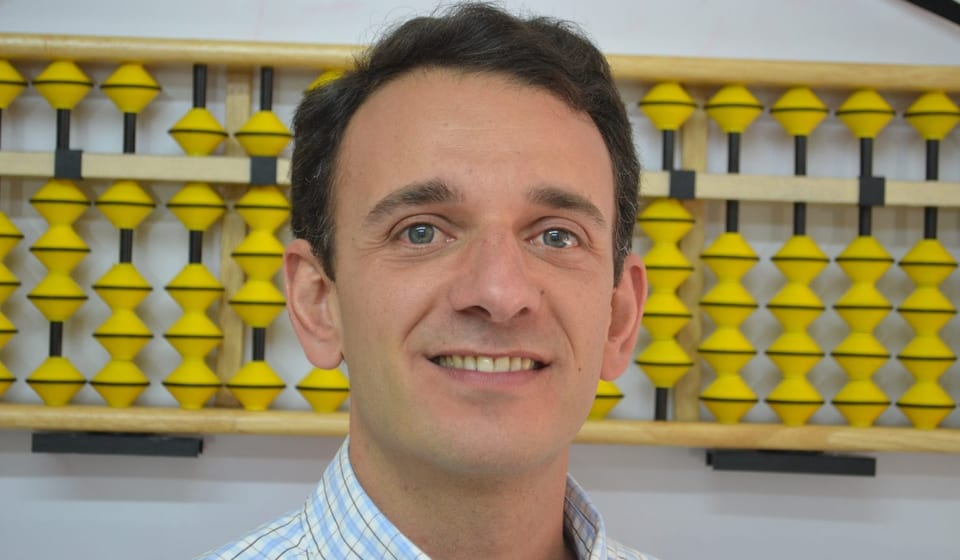
Juan José Chamie
Founder of Yo Sí Cuento
“The Japanese abacus man” · As Cuento con Voz called him
In 2015, Juan José Chamie began teaching the Soroban in in-person classes with Sparkly, a program covered by El Espectador and Cuento con Voz.
In those classes he watched children change: they stopped being afraid of numbers and started calculating in their heads, quickly and happily. Later, teachers trained in the method took the classes to wherever the children were.
Now the method takes its next step: Yo Sí Cuento brings it to the web, with games, a Soroban on the screen and the exam path of Japanese schools, for any child, anywhere.
“It takes away their aversion to math and makes it look easier.”“My eldest son, who is 12 right now, could sit the exam they give in Japan in fourth grade… my daughter improved a lot in math, and more importantly… she now likes it much more.”“We don't try to repeat what school teaches, but to build the skills that improve how they think.”For parents
Technique, time and progress you can measure: everything needed to practice seriously at home.
A digital abacus true to the original: exercises are solved by moving the beads, with bead-by-bead demonstrations.
Exams from 10 to 1 kyu with addition, multiplication and division, plus flash training to visualize the Soroban.
Every level ends with an exam: each subject is passed on its own, and then the next kyu opens.
Daily practice time, best times per lesson and how each exam improves over time.
A clear summary to support practice at home, even if you don't know the Soroban yourself.
Streaks and badges that reward daily practice and mastering each technique.
Teachers see their class's progress and print a report for each student. Kids sign in with the class code and two pictures, no email. Every lesson works in English and in Spanish, so students practice in the language of the class, or in both.
Master the ancient art of the Soroban to unlock new neural pathways and keep your mind vibrant and young. A memory program for adults: short sessions, at your own pace, with no timers.
For kids ages 4 and up
With the Soroban by your side, you will conquer numbers, build unstoppable focus, and succeed in any challenge.
Your superpowers
7 free lessons · no credit card
From age 4, with no upper age limit. Adults can learn too: when they start, they can choose a memory program with calm sessions and no timers.
Both. Every lesson, game and exam for kids works in English and in Spanish: switch with the ES | EN toggle at the top of any page. Bilingual families can practice math in either language. The adults' memory program comes in both languages too.
Yes. Instructions are short, and lesson exercises are answered by moving the beads on the Soroban rather than by writing, so the numbers carry much of the meaning. If a step gets confusing, switch that page to English with the ES | EN toggle and back again.
Yes. Students can practice math in English, in Spanish, or in both, so it works in any classroom, dual-language and immersion programs included. For classes and after-school programs, write to us and we'll put together a school plan.
No. We don't repeat what school teaches: the Soroban builds focus, memory and mental math, the skills everything else is learned with. Ten minutes a day is enough, and it feels like a game.
No. The platform includes an interactive virtual Soroban. We do recommend having a physical one to complement practice.
In the browser on a computer, tablet or phone. There's nothing to install.
One profile with the first 7 lessons, the 15 kyu ones (getting to know the Soroban, direct addition and subtraction, and the number 5), the interactive Soroban and a basic parent dashboard. Anzan (mental math) is in the paid plans. On the free plan, progress is saved only in the browser of the device you use: if you clear its data or switch devices, it's lost.
Yes, we offer a full refund within the first 7 days if you're not satisfied.